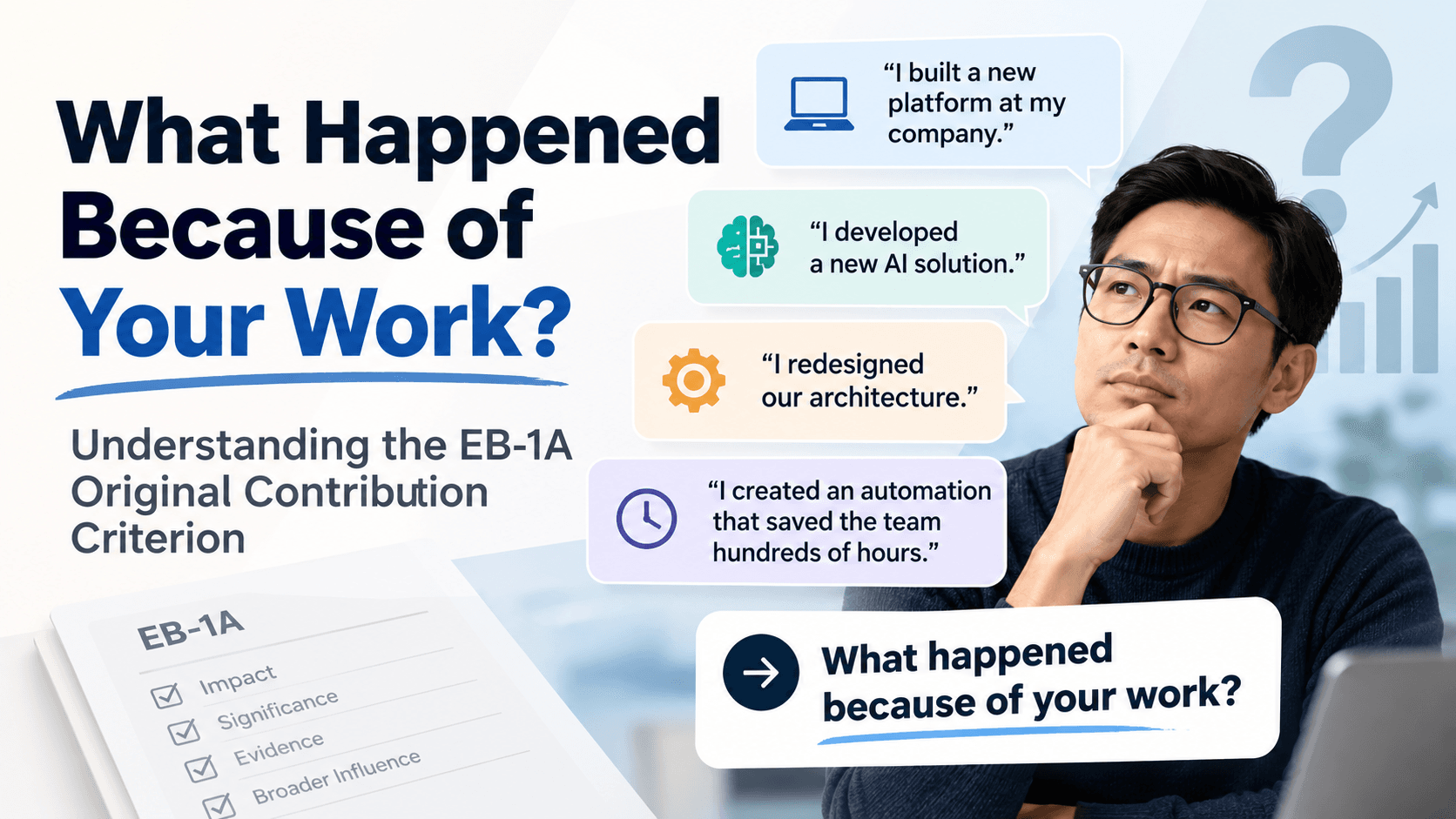
“I built a new platform at my company.”
“I developed a new AI solution.”
“I redesigned our architecture.”
“I created an automation that saved the team hundreds of hours.”
These can all be impressive achievements.
But one of the most important questions when thinking about the EB-1A Original Contribution criterion is: What happened because of your work?
That's where the conversation becomes more interesting.
Great Work and Significant Contribution Aren't Automatically the Same Thing. Experienced professionals solve difficult problems every day. Engineers build platforms. Researchers develop methods. Product leaders launch products. Executives create strategies. Architects redesign systems.
Doing difficult or technically sophisticated work can show that you're very good at what you do. But when evaluating an Original Contribution, simply explaining that the work was difficult isn't always enough.
You have to go further. “What Did You Build?” Is Only the Beginning
Suppose someone tells us: “I designed a new data platform for my company.”
Our next question probably isn't going to be: “What programming language did you use?”
We're more interested in understanding things like: Why was this needed?, What was different about the approach?
What problem existed before? Who ultimately used or benefited from it? What changed after it was introduced? Did its influence extend beyond one small project or team? Was there measurable impact?
Those questions start moving the conversation from what you did toward why the contribution mattered.
Evidence Matters Here Too
Another challenge appears when someone remembers the achievement clearly but has very little documentation around its significance.
For example, saying: “My solution saved the company $4 million.”
naturally leads to another question: Where did that number come from?
That doesn't mean the achievement isn't real.
It means the story needs support.
Understanding what evidence exists and how different pieces of evidence connect to the contribution, is an important part of evaluating whether an achievement may become a strong part of an EB-1A profile.
Don't Start by Trying to Make Everything an Original Contribution
Not every successful project needs to become an Original Contribution story.
And that's okay.
Sometimes we review someone's background and find that the project they initially thought was strongest isn't actually the most interesting part of their career.
Another initiative may have broader adoption. Another contribution may have stronger independent recognition. Another project may have much clearer measurable impact.
That's why profile evaluation should usually come before trying to force individual achievements into particular criteria.
A Better Question to Ask
Instead of only asking: “What did I build?”
keep going.
Ask: “Why did it matter?”
That simple question often changes the entire way someone thinks about their professional achievements.
Not Sure Which Contributions in Your Career Are Worth Exploring?
NicheProfile helps professionals evaluate their existing work, identify potentially meaningful achievements, and understand where stronger evidence or profile development may be needed.
You may already have more in your career than you realize. The first step is understanding what is actually worth developing.